The real terminal
for the AI Native era.
Run every AI agent in one window, see what each is doing, and share context between them.
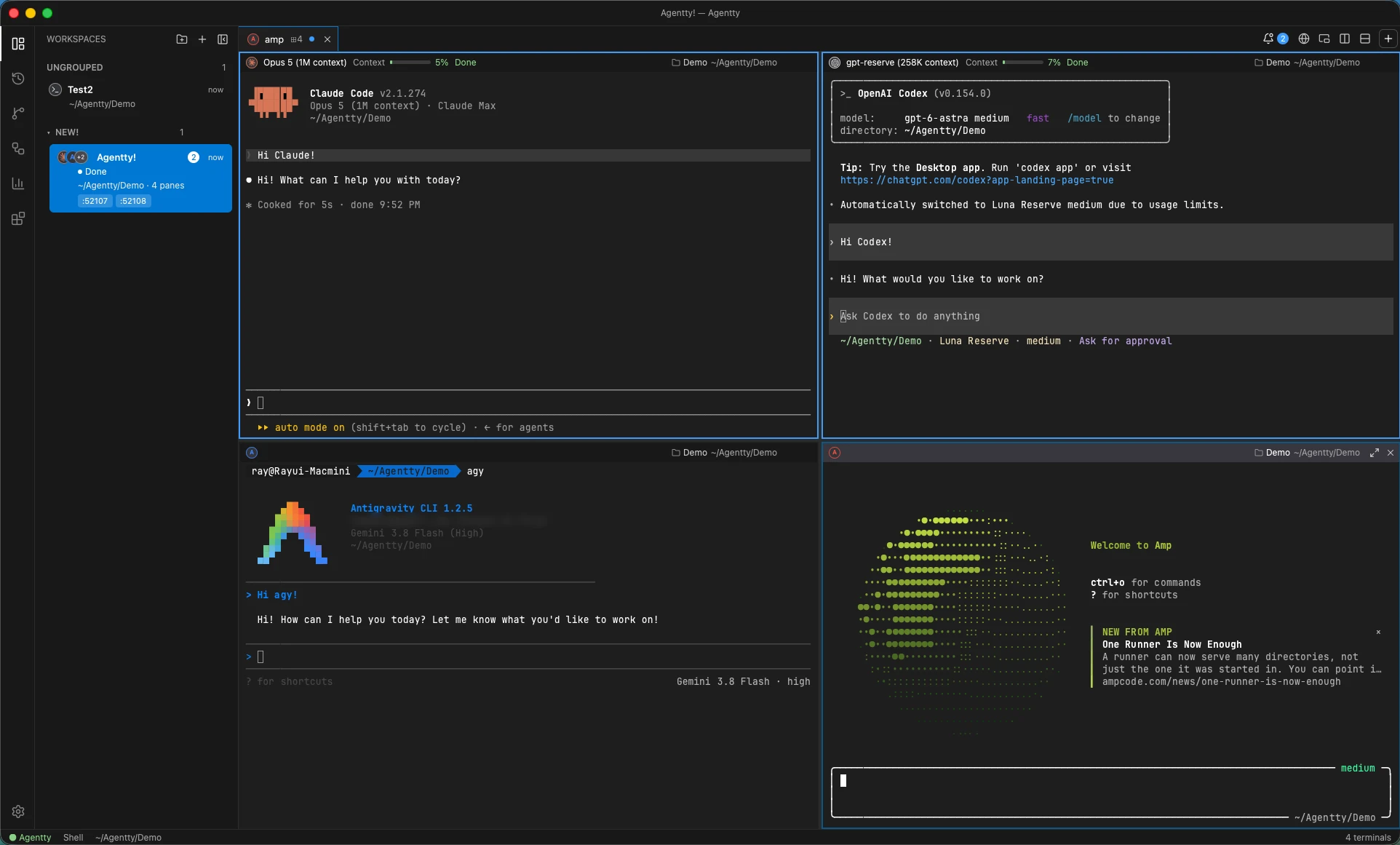
A terminal made for running agents
It knows what your agents are doing
Agentty receives status events from Claude Code and Codex, so it knows when an agent finishes a turn, asks for permission, or needs an answer. The pane gets a highlighted border, the workspace gets a badge, and you get a desktop notification that opens the right pane when you click it.
- Status for every agent: working, done, waiting, or needs permission
- The highlight stays on until you actually look at the pane
- Each pane shows the model, context usage, rate limits and git branch
- See which subagents are running and what they last did
- cd into a project and it offers to resume the last session there
Run as many agents as you want in one window
There's no limit on how many panes or agents you open. Split a tab and start a different agent in each pane. For example, Opus can work on the main change while Codex writes tests and Gemini updates the docs. Workspaces remember their tabs, panes and folders, so after a restart everything is where you left it.
Share context between agents
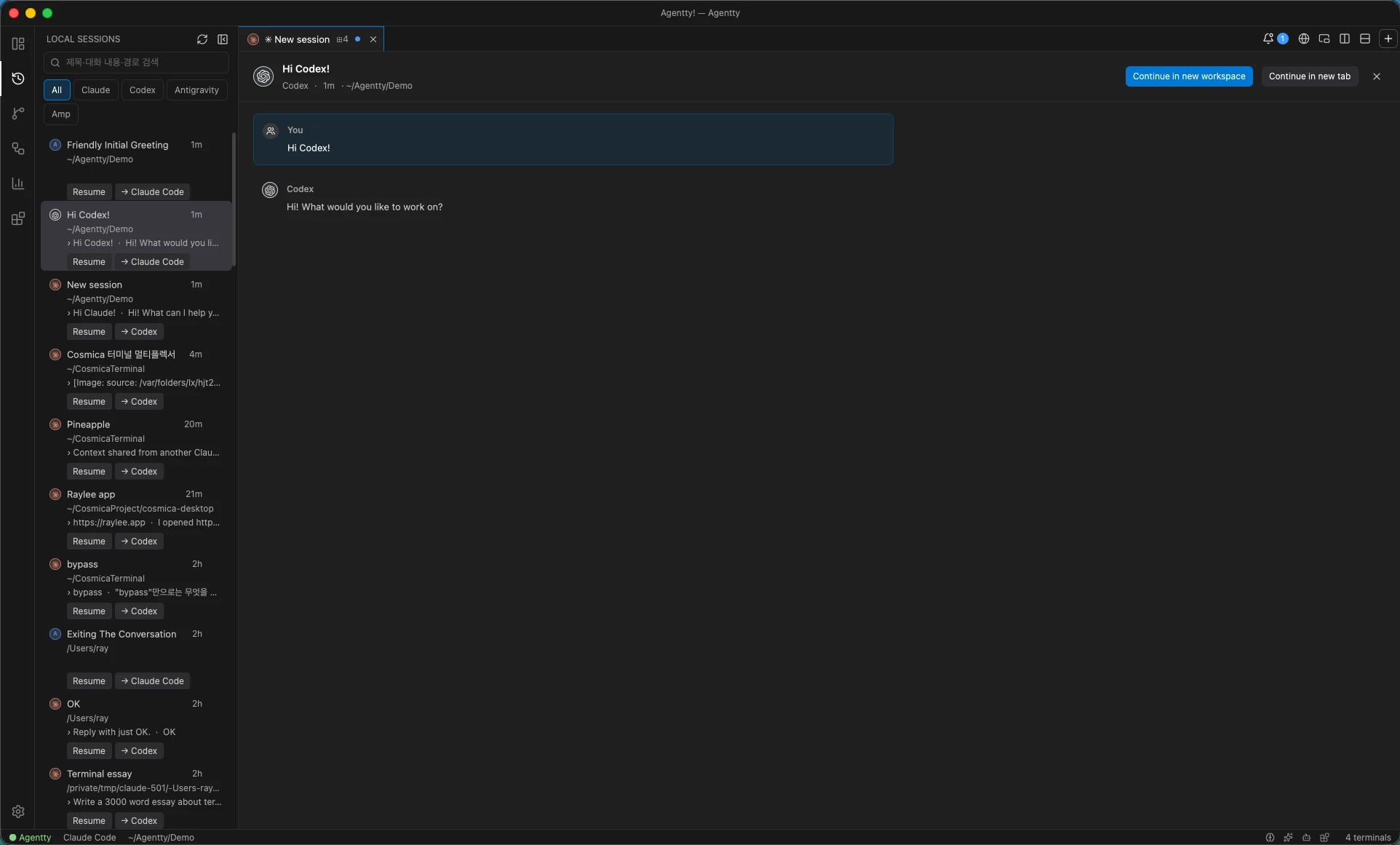
Agentty reads the session files Claude Code and Codex already write on your computer. You can search them, resume any of them, hand a conversation from Claude to Codex, or connect two sessions so one sees what the other is doing.
Everything has a screen you can look at
You shouldn't need ps aux | grep claude to find out what your agents are up to. These pages are part of the app.
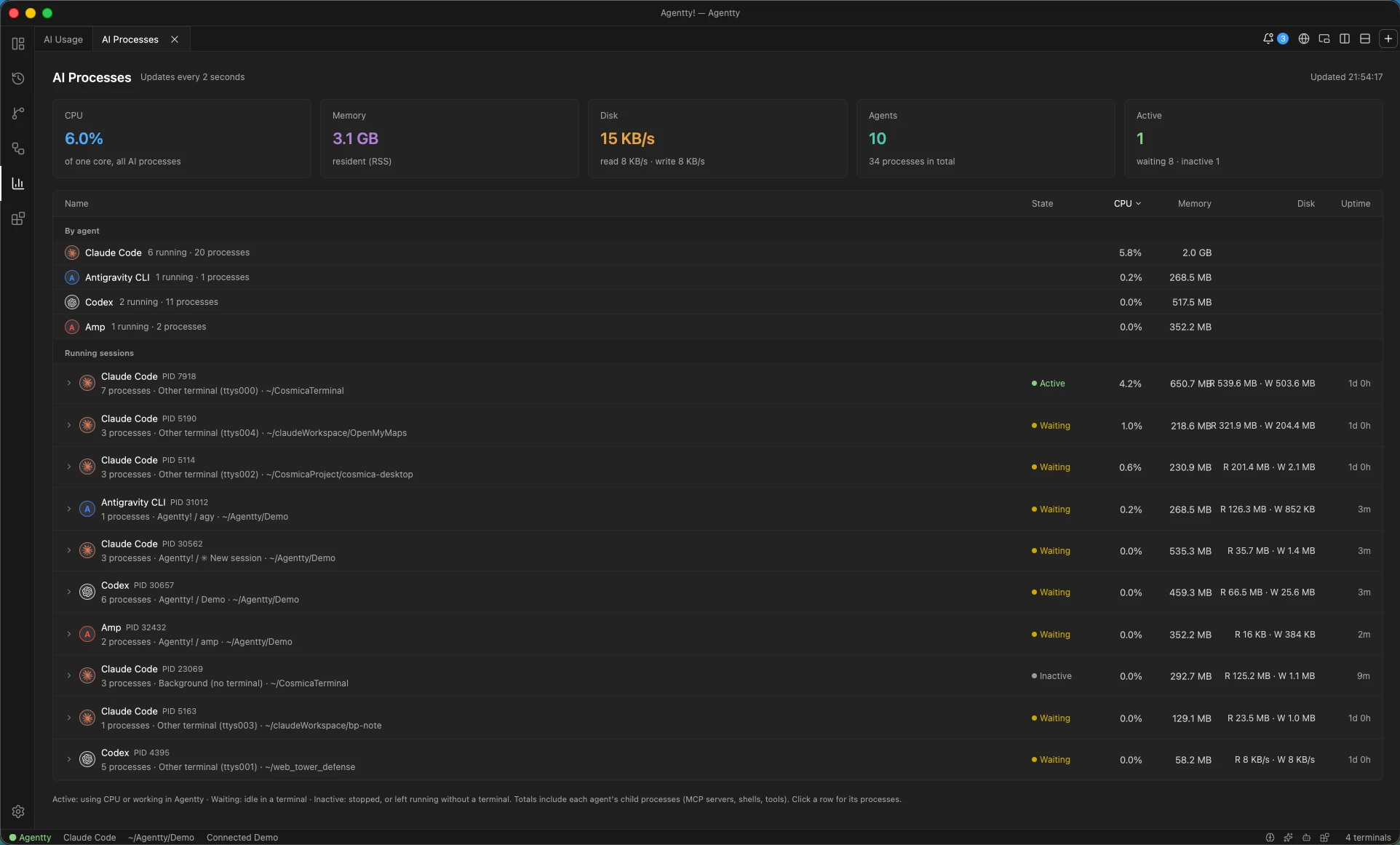
AI Processes
CPU, memory and disk for each agent and session, including MCP servers and child processes. Refreshes every 2 seconds.
Mini mode
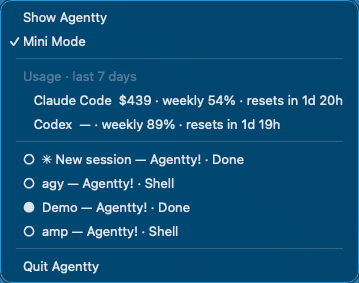
Shrinks the window into a small panel that stays on top. When an agent finishes, a speech bubble pops up.
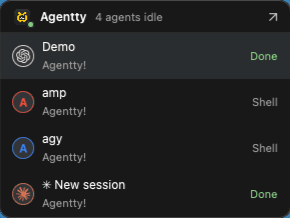
Menu bar
Weekly usage, time until limits reset, and the list of running agents.
AI Usage
Cost, calls, cache hits, tokens, models and tools, calculated from local transcripts.
AgentGit
Git is built in, so you can manage the repo of the session you're looking at. Review diffs, commit, switch branches and merge without leaving the app.
In‑app browser
Open your dev server next to the terminal and see changes as soon as they land. Claude Code and Codex can drive the same browser over MCP, clicking, typing, reading the console and taking screenshots while they build and test.
Extensions & MCP
Skills, subagents, commands, plugins and MCP servers in one list. Official MCP servers can be added with one click.
17MB, and it opens right away
There's no Electron or bundled Chromium. Agentty is written in Rust, uses GPUI to render with Metal, and uses alacritty_terminal for the terminal itself. It leaves your CPU and memory for the agents.
App bundle size on disk
Everything Agentty does, on one page
What we're building next
Idea mode
One flow from idea to development to launching your service. Shape the idea, build it with agents, and ship it, all inside Agentty.
Plugins
Coming soonAdd your own features to Agentty with plugins.
Linux & Windows
Coming soonAgentty on more platforms than macOS.
Open source
Coming soonThe full source code, published on GitHub.
Your conversations stay on your computer
Session lists, usage numbers and handoffs are built from transcript files on your computer, and Agentty doesn't send your conversations anywhere. Agent status events and handoff files are only accessible to your user account. Apart from APIs and MCP servers you add yourself, the app only goes online to check for updates and service status. The agent CLIs still talk to their own providers as usual. We plan to open‑source the code soon.
Frequently asked questions
What is Agentty?
+
Agentty is a native terminal app for running AI coding agents such as Claude Code, Codex, Gemini CLI, Amp and OpenCode. It shows what each agent is doing, runs as many agents as you want in split panes, and lets sessions share context with each other.
Which AI agents does Agentty work with?
+
Claude Code and Codex have the deepest integration, including live status, session management and context sharing. Gemini CLI, Antigravity CLI, Amp, OpenCode, Copilot CLI, Cursor Agent, Qwen Code, Droid, Goose, Crush, Aider and local Ollama models are detected and can be launched from the app.
How is Agentty different from tmux?
+
tmux splits a terminal into panes but doesn't know what runs inside them. Agentty also gives you unlimited splits, and on top of that it knows when an agent is working or waiting for you, manages Claude Code and Codex sessions, passes context between them, and includes an in‑app browser, Git and usage views.
How is Agentty different from cmux?
+
Both are native macOS terminals for AI coding agents with split panes, attention notifications and an in‑app browser. cmux is built on Ghostty and focuses on vertical tabs and a scriptable CLI and socket API. Agentty goes further into the sessions themselves: it links Claude Code and Codex sessions so context flows between them live or both ways, lets you search, resume and move sessions between the two, and adds an AI process monitor, a usage dashboard, a built‑in Git page and MCP server management.
Is Agentty free?
+
Yes, Agentty is free to download. The source code will be open‑sourced soon.
Does Agentty upload my conversations?
+
No. Session lists, usage numbers and handoffs are built from files on your computer. The app only goes online to check for updates and service status, apart from APIs and MCP servers you add yourself.
Which platforms does Agentty support?
+
Agentty runs on macOS 13 or later today. Linux and Windows versions are planned.
Smarter AI development
starts here.
Free to download. The source code will be open‑sourced soon.