
Agentty vs Orca: a native terminal or a full agent workspace
By LEE YONGBEOM · Creator of Agentty · Checked
TL;DR
- Pick Orca if you want GitHub and Linear tasks, design mode and phone apps for iOS and Android in the same window as your agents.
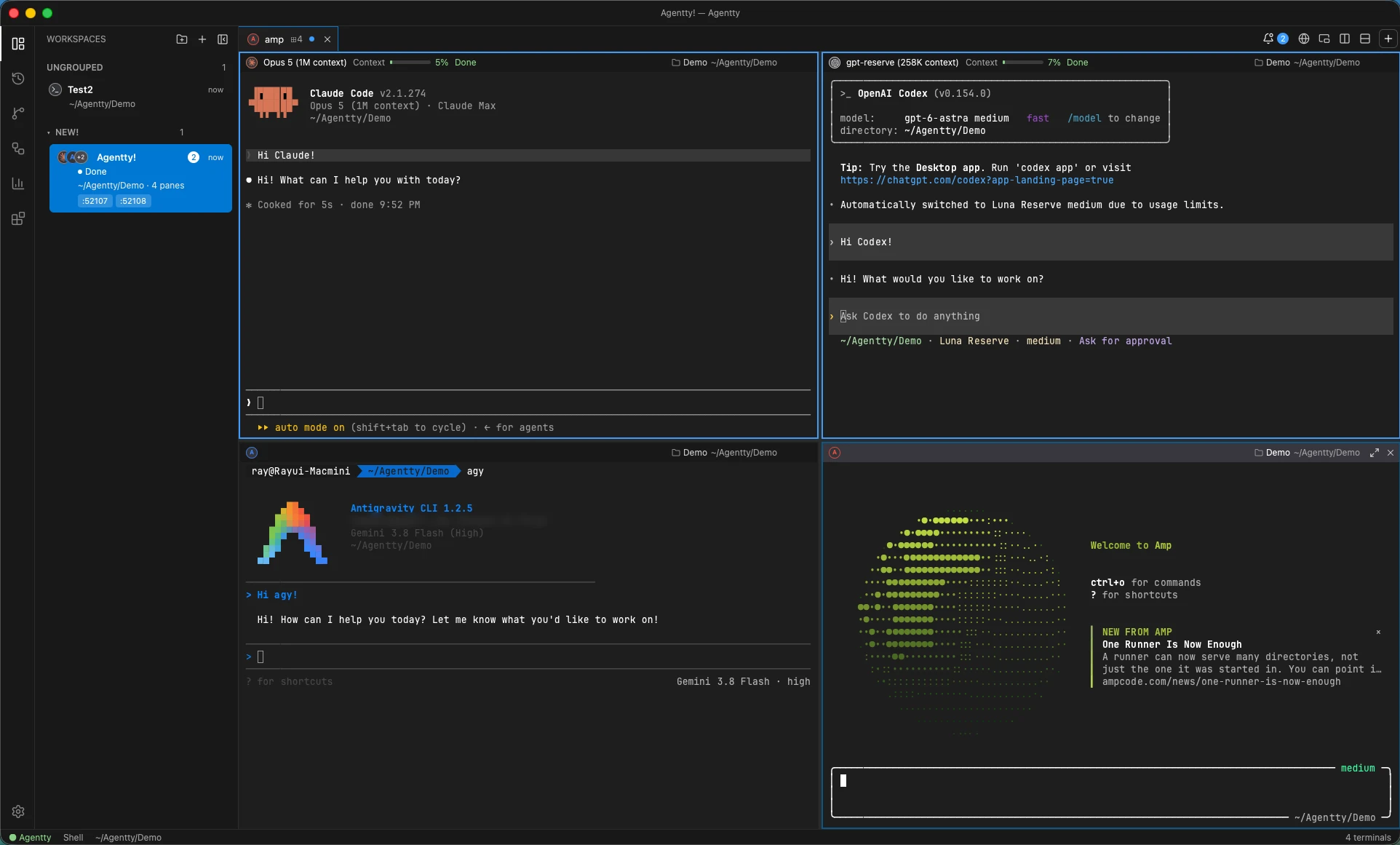
- Pick Agentty if you want a native terminal under 30MB that keeps out of the way, with session search, live context between Claude Code and Codex and an AI process monitor.
- Both run each agent in its own git worktree, on macOS, Windows and Linux, for free.
 ▶ See it run, in under a minute
What each one documents
| Agentty | Orca | |
|---|---|---|
| Plans one goal into a team of agents that runs in waves | Documented | Not documented |
| Claude Code, Codex, Gemini CLI and Antigravity on one team | Documented | Not documented |
| Unlimited split panes | Documented | Documented |
| Knows whether an agent is working, done or waiting for you | Documented | Documented |
| A git worktree per session | Documented | Documented |
| A code editor inside the app | Documented | Documented |
| An in‑app browser the agent can drive | Documented | Documented |
| Open your terminals from your phone | Documented | Documented |
| macOS, Windows and Linux | Documented | Documented |
| GitHub, Linear and Jira issues in the app | Not documented | Partly |
| Resume an agent session | Documented | Documented |
| Search sessions by title, message or folder | Documented | Not documented |
| Move a session between Claude Code and Codex | Documented | Not documented |
| Two sessions linked, context flowing live | Documented | Not documented |
| Usage dashboard — cost, tokens, limits | Documented | Documented |
| AI process monitor — CPU, memory per agent | Documented | Not documented |
| Built‑in Git, with diff and commit | Documented | Documented |
| MCP server management | Documented | Not documented |
These are reference results, compared against each project's open-source code; features may have changed since the comparison was made.
Facts side by side
| Agentty | Orca | |
|---|---|---|
| Built with | Rust, drawn on the GPU | Electron |
| Platforms | macOS 13+ (Apple silicon), Windows 10 1809+ (x64), Linux (x86_64) | macOS, Windows, Linux; companion apps for iOS and Android |
| License | Apache License 2.0 | MIT |
| Install | .dmg, Homebrew cask, Windows setup, .deb, .rpm | Downloads, Homebrew cask, AUR, AppImage |
| Phone access | A browser page over your own Tailscale network (macOS host) | iOS and Android apps |
| Code editor | Built in, with language servers, and edited live alongside a connected Claude Code or Codex session | VS Code-style editor with autosave |
Where Orca is the better pick
- GitHub and Linear. Orca browses pull requests, issues and project boards, and opens a worktree from a task. Agentty does not show issues.
- Design mode. Click an element in Orca's browser and its HTML, CSS and a screenshot go to the agent.
- Phones. Orca has native apps for iOS and Android. Agentty's remote access is a web page, and its host must be a Mac.
- Reviewing diffs. Orca lets you comment on lines of an agent's diff and send them back to it.
- A larger community. About 96k GitHub stars on the day we checked.
Where Agentty goes further
- Native, and small. Agentty is written in Rust and drawn on the GPU, with no Electron, in a download under 30MB.
- Find any session. Search Claude Code and Codex sessions by title, message or folder, resume them, and move one between the two agents.
- Context between agents. Link two sessions so context flows live between Claude Code and Codex, one way or both.
- A process monitor for AI. CPU, memory and disk for every agent, MCP server and child process.
- A lead agent with a team. A chat workspace where one lead agent plans and runs up to four workers with reviewers, each on its own branch.
- Edit beside your agents. Connect a Claude Code or Codex session to a file in the editor: its changes light up at its caret and stay marked until you Keep or Undo them.
How this was checked
Every line about Orca was read off its own README, repository or site on . A “not documented” means the project does not describe the feature, not that it cannot do it. This is a comparison of what each project documents, not a benchmark. If something here is out of date, tell us and it will be corrected.
Frequently asked
- Do Agentty and Orca both use git worktrees?
- Yes. Both give each agent session its own git worktree so parallel agents do not edit the same files.
- Is Orca built on Electron?
- Orca's repository builds with Electron (it lists electron in its package.json). Agentty is a native Rust application.
- Which one is free?
- Both. Orca is MIT-licensed; Agentty is free under the Apache License 2.0, with no account or paid tier.
Sources
- Orca README — checked 18 October 2026
- Orca package.json — checked 18 October 2026
- Agentty README and releases — checked 18 October 2026
- Agentty documentation — checked 18 October 2026